How Does Our Interpretation of Art Change Over Time
Perception in fine art stands for a complex relation between visual stimuli and a personal understanding of them. It is a theoretical postulate that aims to clarify the relation between artworks and individual opinions and evaluations. Far from beingness a universally established matrix of understanding fine art, perception is conditioned by a context from which ascertainment and evaluation are fabricated. Instead of general models of agreement, it is conditioned by numerous factors, including political, social, cultural, gender and racial. It affects how we see fine art and what meanings we attribute to information technology, but is also an agile factor in artistic cosmos. Information technology would be difficult to make assertions virtually the meaning of art without the previously established notions of value that come from multifaceted perceptual conditionings. The views of both an artist and an observer contribute to the understanding of art, and the first is not distinguished in its importance from the second.
Equally seen from numerous historical examples perception affects the meaning we attribute to art, and often such understandings change over the course of time. Some universal postulates may persist, but nearly of them are dependent on the detail social mores of a given time. Perception and our opinions are closely linked. Turning to fine art, nosotros can run across that throughout history evaluation of artistic styles changed over the class of time, which contributes to the above assertion of a connexion betwixt our opinions and perception of fine art.

A Take on Perception with Maurice Merleau-Ponty
In 1945 Maurice Merleau-Ponty published Phenomenology of Perception which put him on the map of modernistic phenomenologists, together with Edmund Husserl, Eugen Fink, and Martin Heidegger. He developed his ain estimation of phenomenology's method, based in Gestalt theory, psychology, neurology, and the critique of prejudices of empiricism and intellectualism. For Merleau-Ponty indeterminate and contextual aspects of the living reality cannot be removed from the whole account of the sensory. Sensing is a "living advice with the world that makes it present to us equally the familiar place of our life."[1] We invest the perceived reality with values and understandings that refer essentially to our lives and bodies, but we often forget that this reality is every bit it appears to these perceived values and that it is non a truth in itself. Moving on to include artistic practices in his word, Merleau-Ponty turns to expression equally the perceptual exchange between an organism and its surroundings. Perception has artistic and expressive dimension that is manifested in fine art, and paintings are manifestations of expressivity of a perceptual style into a more malleable medium.
Merleau-Ponty - The World of Perception and the World of Science
Fine art Styles - A Coherent Deformation
In explaining the development of artistic styles in relation to perception Merleau-Ponty resorts to a language of progress and historical development that establishes the historical trajectory of art as a systematic development starting with our views and understandings, where artist's subjective preferences have no effect. Perception in art, as nosotros mentioned in the introduction, is conditioned by both the observer's and the artist's situatedness. Art styles had developed from a willed conclusion of an artist that casts his inspiration in visual grade inside historical trajectories, and come up equally a coherent deformation in inherited traditions. In art, meanings caused from perception are concentrated in visual expression, and style represents "an estimation, an optional manner of depicting the globe." [2] The unfinished graphic symbol of modern painting, as Merleau-Ponty describes information technology, is not some kind of a turn from objective observation and delineation of the reality to a more subjective vision, but is rather a testimony to a "paradoxical logic of all expression."[three] Two following cases from modern art explain in more detail the fickleness of perception.
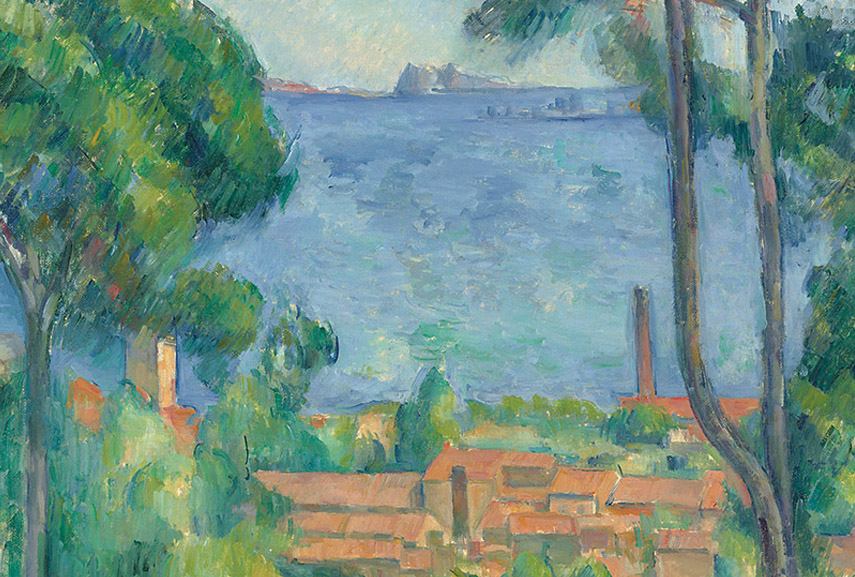
Instance No.1 - Paul Cézanne
Cézanne belongs to a grouping of artists who worked in France at the turn of the centuries and whose paintings were highly criticized past contemporaries. Together with Impressionists he marks the beginning of the new age in art where formal adherence to realistic representation is substituted with expressive renderings where line, course and color accept primacy. In disharmonism with Impressionists, Cézanne desired to develop an analytic style where reality would be simplified and explained through basic shapes. In observing how the appreciation of his works changed over decades, from being rejected numerous times by the Paris Salon to being hailed today as the forerunners of modernistic art, nosotros can understand the influence perception has on our views. Unaccustomed to see the world simplified to basic forms in art, Cézanne'southward critics described his paintings every bit extremely ugly, while Camille Mauclair, an anti-modernist writer, noted that "Cézanne never was able to create what can be called a picture."[4] Yet, Merleau-Ponty describes his works as a proto-phenomenological decision to represent the birth of perception through painting.[5]
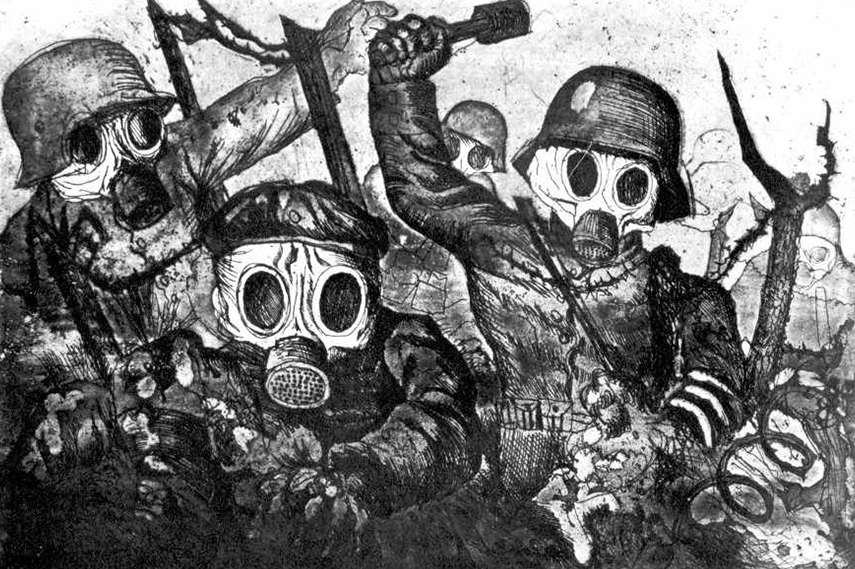
Example No.2 – Degenerate Art
Perchance the near notorious example in the history of fine art is the exhibition staged in Munich in 1937, named Degenerate Art or Entartete Kunst. Its title came from a broader decision by the Nazi regime to classify artistic practices by their ideological ceremoniousness. The show that toured several other cities in Deutschland ridiculed and derided modernistic fine art, and those who produced information technology faced astringent consequences later. Mod art was seen as un-German language, Jewish or Communist, and in contrast to claret and soil ideology of the Nazi Political party. Oto Dix, El Lissitzky, George Grosz, László Moholy-Nagy, Piet Mondrian, and Paul Klee were among the artists whose works were shown, and many fled the Federal republic of germany in the aftermath or were stripped of their professorships and forced to live in exile. Negative perception of their art by the ruling elites, blinded by ideological, racial, and nationalist prejudices, outlawed some of the virtually valued modern artists and art works, and affected cultural production in Deutschland that turned to idealized representations of the national that, besides historical, have niggling or no value today.
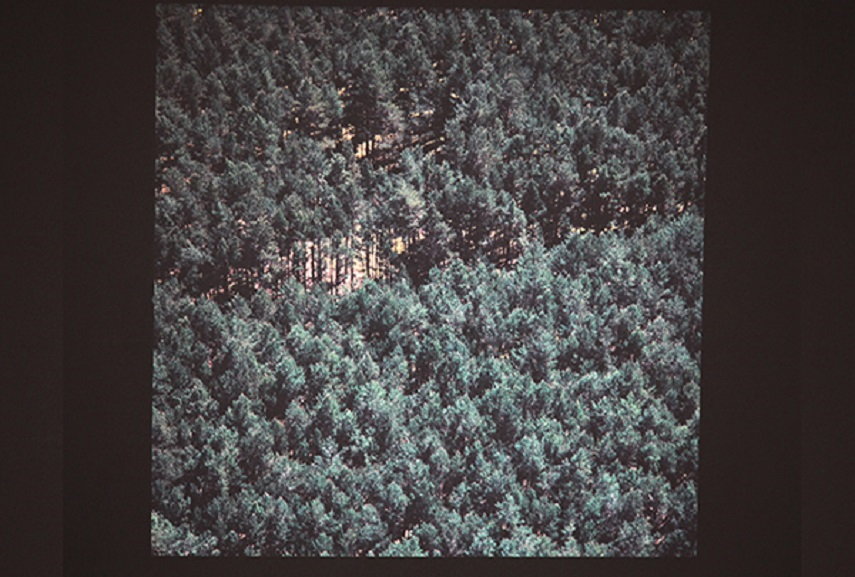
Perception in Art - Gimmicky Moments
There is no departure in how art is perceived today and what factors affect our understanding of it. Our views are still formed by circuitous influences, and perception is not divested from them. Nosotros could make numerous examples from contemporary art proving that perception is far from existence rendered objective or unaffected by our personal standings. Graffiti and street art could serve as a good example. Instead of beingness observed as another art form, graffiti, which still today provoke mixed responses, were in the starting time synonymous with a decaying urban environment, and urgency from the officials to eradicate them came from a need to bring gild in a cluttered social reality.[half dozen] Another example that testifies to complexities inherent in perceptual agreement is Susanne Kriemann's 80-piece slide projection - 277569. This intriguing piece comprises of photographs showing a wooded surface area that is not specified. The number that stands for the title likewise gives out piddling a propos the content. As the artist explains, photos are taken from an annal, and correspond the expanse that was flown over 277,569 times during the Berlin Airlift in 1948/49. They are historical markers of the commencement of the Cold State of war, but this information is buried for the observer beneath the numerous, almost bathetic forms of copse that are their main protagonists. Artist's perception of these photos as a historical testimony, and the viewers' often uninformed guesses, position this artwork betwixt the contrasting understandings which inform every practice of meaning making. Belonging to the domains of abstruse photography and historical document, 277569 is a skilful example of how perception and social conditionings affect our views of art.


Editors' Tip: Merleau-Ponty and the Art of Perception
This collection of essays brings together diverse just interrelated perspectives on art and perception based on the philosophy of Maurice Merleau-Ponty. Although Merleau-Ponty focused about exclusively on painting in his writings on aesthetics, this drove also considers verse, literary works, theater, and relationships betwixt fine art and science. In addition to philosophers, the contributors include a painter, a photographer, a musicologist, and an architect. This widened telescopic offers important philosophical benefits, testing and providing evidence for the empirical applicability of Merleau-Ponty s aesthetic writings. The central statement is that for Merleau-Ponty the business relationship of perception is also an account of art and vice versa. In the philosopher s writings, art and perception thus intertwine necessarily rather than contingently such that they can only be distinguished by abstraction. As a outcome, his account of perception and his account of art are organic, interdependent, and dynamic.
References:
- Merleau-Ponty M., (2012), Phenomenology of Perception, p. 53.
- Merleau-Ponty M., Johnson G. A., Smith One thousand.B., (1993), The Merleau-Ponty Aesthetics Reader: Philosophy and Painting, p.238.
- Toadvine T., Maurice Merleau-Ponty , plato.stanford.edu. [December v, 2016]
- Flam J., (2012), Bathers only not Beauties , artnews.com
- Merleau-Ponty Grand., (1945), Cezanne's Doubt , powersofobservation.com [December v, 2016]
- Ross J.I., (2016), Routledge Handbook of Graffiti and Street Fine art, p.408.
Featured images: Esther Stocker - Space Installation. Image via lodownmagazine.com; Graffiti Art.Images via Widewalls annal; Laszlo Moholy Nagy - Photogram. Image via Widewalls archive. All images used for illustrative purposes just.
Source: https://www.widewalls.ch/magazine/perception-in-art
0 Response to "How Does Our Interpretation of Art Change Over Time"
Post a Comment