Planreview Checklist for Homes and Buildings Navajo
Tribal Green Building Codes
Tribes, as sovereign nations, have broad opportunities to redefine the purpose, telescopic, goals, and design of their systems to guide and manage construction on tribal lands.
Where no building codes are in force, tribes may have reduced control, or be subject to the awarding of codes that practice non support sustainable and healthy building practices.
Building codes in general take definite benefits when properly developed and implemented, including:
- Health and prophylactic
- Environment
- Tribal Culture and Community Evolution
- Tribal Sovereignty/Cocky-Sufficiency
- Economical
Compared to historical tribal dark-green building practices, piddling exists today. Withal, opportunities be and keep to evolve to support more than sustainable tribal housing. For example, the Native American Housing Assist and Self Determination Human action (NAHASDA) Exit passed by Congress in 1996 provides tribes the flexibility to adopt and use their own building codes in NAHASDA-funded programs.
Acknowledging the groovy multifariousness of tribes' goals for sustainable building, this guidance is a resources for tribes, wherever they are along the spectrum; from adoption or adaptation of existing edifice codes and standards, to fundamentally different or innovative approaches to building.
This Tribal Green Building Authoritative Code Instance can be used as a template for technical code selection (i.e., building, electrical, plumbing, etc.) to exist adopted equally a comprehensive building code.
For additional examples, the Native American Rights Fund, National Indian Police force Library maintains a web-based itemize list tribes that accept adopted edifice codes Exitwith link to those codes.
Code Contents
On this page:
- What is a Building Code?
- Green Building Codes
- Tribal Green Edifice Codes
- Building Code Contents
What is a Building Lawmaking?
Building codes are regulations, technical provisions, and referenced standards establishing minimum requirements for the construction, alteration, maintenance and demolition of buildings.
Codes are typically enacted by ordinances or laws adopted by local, regional, state, or tribal governments. Codes are laws that outline legal requirements that must are made mandatory provisions that become enforceable when adopted by statute or ordinance.
Conventional building codes were designed to protect human being health and safety primarily from physical hazards, as well as to protect property and structures from fire, weather, and seismic events.
Of the numerous model building codes available today, none were adult by or specifically for tribes, or with significant tribal involvement. As a consequence, model building codes may not meet tribes' needs or priorities. At the same time, building codes are important because they guide construction practices for light-green and good for you edifice and are often required to secure funding for construction projects.
There are two basic types of building codes:
- Prescriptive codes that ascertain both what must be done and how it is to be accomplished, and
- Performance or result-based codes that describe what must exist accomplished just exit the "how" upwards to those designing and submitting plans for approval.
Most of the existing codes in the U.Southward. are prescriptive, though some also have performance criteria included.
Green Building Codes
Green building practices protect the natural environment, accost health concerns related to indoor environmental quality, the toxicity of materials throughout their life cycle, reducing waste, and conserving energy, water, and other resource.
Over the past few decades, increasing awareness and evidence almost the meaning impacts related to the built environment gave rising to the "green" building movement. As light-green building practices, programs, and rating systems were adopted, building codes and standards needed to address these issues.
California was the first state in the U.S. to incorporate greenish edifice requirements into their statewide building code with the adoption of a ready of building provisions called CALGreen. Get out They began the adoption process by instituting the model code on a voluntary ground; nonetheless, by 2011 many green provisions became mandatory for all buildings in the State -- except tribal and federal edifice activities.
The American Society of Heating, Refrigerating and Air-Conditioning Engineers (ASHRAE) publishes the Standard for the Design of Loftier-Performance Green Buildings Except Depression-Ascension Residential Buildings (ASHRAE 189.1). Exit This publication, is intended to serve as a model building lawmaking on a national basis.
In 2012, the International Code Council developed the International Green Construction Code (IgCC). Exit Like ASHRAE 189.1, IgCC contains provisions for improving the environmental and health performance of commercial and loftier-ascent residential construction.
The U.S. Department of Energy's Going Beyond Codes: A Guide for Creating Effective Green Edifice Programs for Energy Efficient and Sustainable Communities (PDF) (124 pp, 3.28M) Leave provides an overview of light-green codes, rating systems, and other standards.
Tribal Green Building Codes
Tribal green building codes are, first and foremost, defined past the Tribe. One fashion to think of edifice codes is equally an evolving progression from conventional codes that address the physical safety of people, to green codes, that also incorporate concerns about human and ecological health and resource conservation.
To larn more most tribal green building practices and codes, download EPA's Tribal Green Building Toolkit.
Building Lawmaking Contents
Building codes are typically not single documents, but rather a serial of documents setting requirements for different edifice types (residential and commercial) and for various aspects of construction such as:
- Fire safety
- Mechanical systems
- Plumbing systems
- Energy conservation
- Fuel gas
- Private sewage disposal systems
- Existing buildings
- Wildland-urban interface
Within these various codes, provisions cover these and other topics:
- Siting
- Structural integrity
- Fire safe
- Emergency exiting
- Materials
- Lighting
- Heating
- Cooling and ventilation systems
- Electrical systems
- Plumbing and sanitation facilities
- Utility connections
- Radon
- Artful suitability
More recently, code provisions take begun to include:
- Conservation measures for energy, water and materials
- Indoor air quality and toxicity of materials
- Social and cultural suitability
Adopting Tribal Codes
On this page:
- Adopting Existing Codes
- Adapting or Amending Existing Codes
- Developing and Adopting Tribal Codes
Developing and maintaining building codes requires a tremendous investment of fourth dimension, effort, and expertise. Because of this, referencing existing green building codes and standards tin can exist very helpful.
Though many codes and standards may non fully address tribal priorities, they incorporate useful technical data and feel. Where appropriate, tribes tin use, partially or completely, existing codes and standards to meet their priorities. Tribes may also develop an entirely new tribal lawmaking or system.
Adopting Existing Codes
The most mutual and to the lowest degree enervating arroyo to putting codes in place is to adopt model building codes. Governments adopting model codes consider which codes to adopt, as well equally any related appendix chapters and referenced standards. It is as well of import to consider local climatic and geographic design criteria, including historical temperature and weather data such as:
- Frost depth
- Wind and snowfall loads
- Flood risks
- Local conditions (seismic risk factors, termite intensity, radon risk, etc.)
Amendments to model codes tin be made to incorporate the goals and concerns important to the adopting tribe.
A consideration in adopting codes is that model edifice codes are ordinarily sets of lawmaking and standard documents roofing different building types (residential, commercial), and different aspects and building systems (burn down, construction and full general safety provisions, plumbing, mechanical, electrical, energy conservation, and at present, greenish edifice). This can have cost implications since, for example, purchasing model codes and standards can be expensive. When adopting model codes, nearly jurisdictions only prefer the model codes that are relevant to their needs.
Because model codes tin can exist complex, it is important to consider the relationship between unlike codes, or dissimilar editions of the aforementioned sets of model codes, to avert contradictory or inconsistent requirements. To avoid these issues, a common practice is to prefer model codes in sets (usually of the aforementioned edition/twelvemonth) rather than choosing codes developed by different organizations.
Many factors influence which codes to adopt. A central factor is the want to have building codes reasonably match those of the surrounding region to ensure that experienced designers and contractors are available to design and build to the code.
Where building codes have non been adopted, the process usually requires creating a edifice department or some other governance structure responsible for interpreting and enforcing codes and establishing financial support for these activities. Fees for permits, programme review and inspection procedures, and other services provided should be developed. The International Code Council's lawmaking adoption resources Leave includes data nigh the procedure of adopting building codes.
Finally, this process involves much more than adopting a gear up of codes. The capacity to properly interpret and enforce the codes is critical. Even the all-time codes, if not enforced properly, cannot provide the intended protection and benefits.
Example: Kayenta Township, Navajo Nation
The Kayenta Township, Exit in the Navajo Nation, went through the whole procedure: establishing a building section, developing a code adoption and enforcement procedure, and hiring staff to carry out the work of permitting, inspection and code enforcement.
In that process the Township adopted the Kayenta Township Edifice Codes, including many of the ICC model codes, including an early version of the International Green Construction Code (IgCC). Amid the many considerations that the Township used for their decision to adopt the 2006 editions of the International codes, was that the 2009 codes required residential burn down sprinklers, which they did not think were advisable for many new homes inside the jurisdiction. The Kayenta Building Official describes the process they went through in a presentation: Kayenta Township Edifice & Condom Section, Tribal Green Building Code Summit Presentation. A cursory outline of this procedure is below.
Conduct Initial Research
- What building codes or standards have been applied in the region?
- What blazon of construction is driving the market (Commercial or Residential)?
- What standards are professional registrants of record referencing?
- What codes or standards were used in the construction of buildings in the community?
- Are insurance carriers insuring backdrop in the community?
Place Other Authorities Having Jurisdiction Over State and Take Adopted Building Codes
- Tribe
- State
- County/Municipality
- Utility
Asking for Assistance from Local Jurisdiction for Building Code Adoption
- Maintain consistency in the region
- Establish peachy partnerships up-front
- Identify and address obstacles that be
- Maybe share resources
- Why re-invent the wheel?
Procedures for Adopting Tribal Code/Ordinance (volition vary by tribe)
- Organization and Format of Lawmaking Detect and Reading Requirements
- Public Participation; Written Statements
- Process for Enacting/Adopting an Ordinance or Rule
- Constructive Date of Ordinances and Rules
Develop Code Implementation and Enforcement Authority
- Build tribal code expertise (training, staffing)
- Coordinate with external inspectors (local, country, contractors)
Adapting or Alteration Existing Codes
Some tribes adjust or improve building codes to assert cultural sovereignty, accost tribal priorities, and build tribal chapters.
In the procedure of adopting building codes, it is common for the adopting regime to make changes to them by deleting or adding parts or changing specific provisions. This is typically washed to accost specific local concerns, weather, or opportunities.
Amendments likewise often specify which appendix chapters or other rules or policies are adopted or excluded and what specific practices are to be adopted or exempted from coverage. In general, provisions provided every bit appendix chapters of codes are included as optional choices.
Some code appendices can include green options. For example, the California'southward Greenish Building Code (CALGreen) Exit residential and not-residential voluntary dark-green measures are included in the code as two appendix chapters. Appendix chapters can also include things like gray water reuse, rainwater harvesting, or interface measures with land apply plans, such as assuring solar access.
A proficient way to observe examples of code amendments is to look at country and local code adoptions. The Bulk Resource Exitsite provides gratis access to many country and local building codes.
Lawmaking Electives, Tiers or Options
Other examples include the Oregon Accomplish Code Exit and the Massachusetts Stretch Energy Code. Exit
Code Electives
When the Kayenta Township adopted the 2010 International Greenish Structure Lawmaking Public Version 2 (IgCCPV2), they adopted specific jurisdictional requirements and projection electives in the Kayenta Township Edifice Codes and in some cases amended it to meet their needs. The IgCC(PV2) jurisdictional electives adopted by the Township included the following specific requirements roofing:
- Conservation Expanse
- Agricultural Country
- Greenfield Sites
- Site Disturbance Limits on Greenfield Sites
- Stormwater Direction
- Light Pollution Control
Adopting Specific Code Edition to Meet Tribal Needs
(e.g., Lack of Infrastructure for Fire Sprinklers in Homes)
Some tribes may find that an earlier edition of a model code fits their state of affairs better than the most recent edition, and thus reduces the number of amendments needed. For instance, tribes in extremely rural or remote locations may lack of infrastructure and services for fires sprinklers or other lawmaking requirements, making standard codes inappropriate or unreasonably expensive.
This was part of the reason the Kayenta Township chose the 2006 rather than 2009 editions of most of the I-Codes. In particular, the 2009 International Residential Code requires fire sprinklers in homes, which makes piddling sense for houses built in rural locations without water infrastructure. On the other hand, they chose the 2009 International Energy Conservation Code (IECC) because they preferred the energy lawmaking provisions in that edition to those in the 2006 IECC.
Code Amendments
Other amendments the Kayenta Township made to their codes equally tin be seen in the Kayenta Township Building Codes. They used asterisks (*) to indicate within the trunk of the code the type of subpoena that has been made:
* - Indicates amendment(southward) have been made to section.
** - Indicates new text has been added to section.
*** - Indicates a new section or exception has been added.
**** - Indicates a section or exception has been deleted in its entirety.
The amendment process tin be a adept style for tribes to introduce provisions covering their own historic or traditional designs and edifice methods and materials, or more generally, for regionally appropriate materials or methods non currently bachelor in local, country, or national model codes.
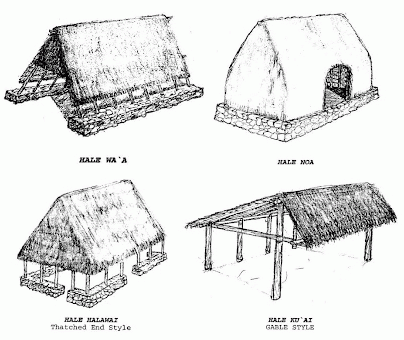 Indigenous architecture examples, Maui, Hi. Run into the "Rules Pertaining to Indigenous Hawaiian Compages Structures (PDF)" (36 pp, 1.7MB, About PDF) Get out Traditional Structures
In Hawaii, the County of Maui has adopted codes for construction of Indigenous Hawaiian architectural structures Go out outlined in Chapter 36 of their edifice code. An excerpt from Maui'south lawmaking:
"This code shall be administered with due consideration given to the Canton policy that ethnic Hawaiian architecture furthers the Canton'due south compelling interests in cultural, environmental, and historic preservation; energy efficiency; economic development; artful beauty; and public safety."
Alternate Materials, Designs and Methods of Structure
Maui County, Hawaii Code of Ordinances, Title 16.26 – Buildings and Structure – Affiliate 16.26.104 amended. An excerpt from Section 104 of the Maui Compatible Edifice Lawmaking is below:
Section 104 of the Uniform Building Lawmaking reads:
"104.two.8 Alternate materials, alternating blueprint and methods of construction. The provisions of this code are not intended to prevent the apply of whatsoever material, alternating pattern or method of construction not specifically prescribed by this lawmaking, including elements based on or inspired by principles of indigenous architecture, such as those associated with structures comprised of either stone walls or wood frames for the bottom portion of structures and thatch of different native grasses and leaves for the roof, provided whatsoever alternate has been approved and its apply authorized by the building official…
…The following material are examples of the types of material that may be considered past the building official, if used for the construction or renovation of a structure that is based on or inspired by principles of indigenous architecture: Wood for house timbers (walls): hamau, kauila, lama, nioi, and 'ohi'a; and House thatch and lining material (roof): lala 'ama'u (fern fronds), lauhulu and lau mai'a (banana leaves)..."
Adopting Lawmaking Flexibility to Back up Living Building Challenge (LBC)
 The organization which has developed the LBC, the International Living Future Institute Exit sponsored an affordable housing Living Building Challenge contest, the Living Aleutian Dwelling Design Contest Exitin cooperation with the Aleutian Housing Authority in Alaska. The Living Building Challenge (LBC) Go out is a certification program designed to encourage built projects which go beyond minimizing harm to create projects that are benign across the spectrum of their impacts. The LBC is an emerging standard for restorative and regenerative edifice projects, going far across the minimum requirements of even the well-nigh avant-garde green building and land employ codes.
Seattle, Washington Get out has developed a airplane pilot that gives their land use and building departments greater flexibility in enforcing codes to enable and encourage these high functioning projects to be congenital. This approach also can utilize to creating and adopting tribal codes and systems.
Amending Codes to Remove Barriers
Organizations that create building codes typically recommend that their codes be adopted without amendments. Yet, the needs of each jurisdiction and community are different. It tin exist helpful to inquiry how similar communities have created their amendments.
- Limited Rural Access to Facilities for Edifice Materials Recycling
Kayenta Township on the Navajo Nation determined that due to their rural location and limited edifice materials recycling markets that they could not currently run across the minimum 50% Structure and Demolition Debris Recycling option in the IGCC Table 302.1, Department 502.one, so they adopted it with this amended language: Minimum percentage of waste material diverted from landfills — 20%. - Increased Kitchen Ventilation
Some tribes may face housing overcrowding that leads to cooking for large numbers of people on a continuous basis. To reduce poor indoor air quality and mold associated with cooking, building codes tin exist amended to increase kitchen ventilation requirements. For some tribes, using outdoor kitchens has been a applied solution for avoiding indoor air quality issues caused by indoor cooking. Building codes tin can be amended to include outdoor kitchen facilities. - Doors Facing East
Traditional Navajo houses were built with the door facing E so they could greet the rising lord's day every morning. Code linguistic communication could be incorporated to support this cultural priority.
Developing and Adopting Tribal Codes
Some tribes are working to develop their own edifice codes to assert cultural sovereignty, accost tribal priorities, and build tribal capacity.
The Pinoleville Pomo Nation's Leave citizens wanted to design homes and associated codes that are expressions of Pinoleville Pomo culture, and farther tribal goals of political sovereignty and environmental protection. The Tribe created its own performance-based standards that permit the highest degree of blueprint freedom, while also protecting health, safety and well-being of: electric current residents, neighbors, and future generations of people and not-humans that share local ecosystems.
Process: Developing Tribal Performance-Based Codes
- The Pinoleville Pomo Nation (PPN) participated in a co-pattern procedure developed by the Academy of California, Berkeley'southward Community Assessment of Renewable Energy and Sustainability (CARES) Exit to design HUD-funded housing that is culturally-inspired and meets tribal goals for sustainability, environmental harmony also as political and economic sovereignty.
- The tribe adult draft operation-based codes: Typhoon Pinoleville Pomo Nation Tribal Green Building Code.
The Last Design Included
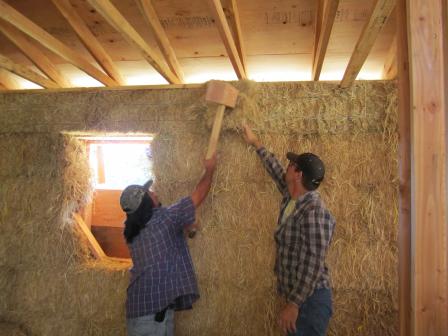 Pinoleville Pomo Nation used HUD funding to build green homes congenital with local straw and earthen materials and EPA GAP funding to support the development of Tribal Greenish Building Codes.
- Renewable energy production and energy conservation to reduce dependence on outside service providers and to assure tribal reliance on clean energy.
- Water conserving technologies such as gray h2o and rainwater catchment systems to reduce vulnerability to water shortages and support the on-site production of gardens.
- Green/healthy local building materials such as straw bale, earthen plaster, not-toxic paints to address priority health bug among tribal citizens associated with housing.
- Social sustainability strategies including the grooming of tribal labor, local-sourcing of materials, employing technologies that let for local maintenance and upkeep, and building strategies that re-enforce tribal customs bonds through shared labor, shared involvement in design, and community pride in housing, and the creation of spaces for gatherings, including large kitchens and outdoor areas.
- Cultural elements such equally rounded walls, due east facing windows, spaces for prayer and reflection, and spaces for practicing traditional tribal arts.
Procedure Overview
- Identify community goals and values
- Co-pattern
- Develop a code template
- Technical partner review
- Create a library of documents
- Develop Tribal Code Review Panel arrangement
The Pinoleville Pomo Nation Process
- After the initial blueprint was completed, the PPN sought technical experts who supported the co-design process, and respected tribal desires. This was particularly important considering during the edifice phase, modifications to the design were necessary to bargain with budget and technical barriers
- Once a final design was settled on, they developed a tribal code template to lay out the key tribal goals for construction and the underlying values. The template includes performance standards that should be met, simply allows designers and builders (including tribal citizens) to exist artistic in how those standards are met. PPN had law students review the template and include language that improves accountability of designers and builders, but maintains a large caste of creative freedom.
- Engaged technical partners again to figure out what resources and references, including existing codes, could be used to back up the construction project.
- Accumulated resources and created a library of "code-relevant" documents.
- Planned to develop a Code Review Panel system at the tribal, regional, and national levels to address specific lawmaking issues. The Review Console plan proposed to include citizens who tin continue tribal values "forepart and center" in the review procedure, and technical green building experts to identify potential problems with the design and construction of the buildings, evaluate the final production, and monitor the edifice's ongoing functioning.
Building Codes (Codes, Standards, Ratings, Labeling)
On this folio:
- Overview of Code Development Organizations
- Green Edifice Labeling Systems, Codes and Standards
- Tribal Buildings Certified Under Rating Systems
- Tribal LEED Projects
- Light-green Globes®
Overview of Code Evolution Organizations
In the U.S., model building codes are developed by organizations whose principal membership typically includes the governmental officials responsible for enforcing related areas of codes and regulations. They mostly utilize a comment-driven development procedure open to interested parties, including tribes. These include buildings, burn down and electrical systems, and plumbing and mechanical systems.
The U.Southward. does not have official national building codes developed through a federal or national process and adopted uniformly nationwide. Instead, there are recognized organizations that develop codes and standards that are adopted by state or local (municipal or county) governments, every bit well as by tribes, who may also alter model codes to meet their specific needs.
The codes and standards gain their enforcement authorization through the state and local government adoption processes. Because of this, at that place is little uniformity beyond the land and states and local governments are able to alter the codes they adopt. Some states and a few cities have their own codes. For tribes, this provides more options from which to choose appropriate code language.
Green Edifice Labeling Systems, Codes, and Standards
For information on Tribal Green Building equally well as labeling systems, standards, codes, and tribal case studies, download EPA'southward Tribal Light-green Building Toolkit.
EPA too has information on a variety of Green Edifice Standards, Codes, and Rating Systems.
Tribal Buildings Certified Nether Rating Systems
Rating systems are commonly voluntary industry technical guidelines for how to construct, renovated, or operate a building.
Leadership in Free energy and Environmental Design (LEED) Rating System Leave
Developed by the U.S. Dark-green Building Council, LEED certification provides independent, third-party verification that a building, home or customs was designed and built using strategies aimed at achieving loftier performance in key areas of human and environmental health: sustainable site evolution, h2o savings, energy efficiency, materials selection and indoor ecology quality.
Tribal LEED Projects
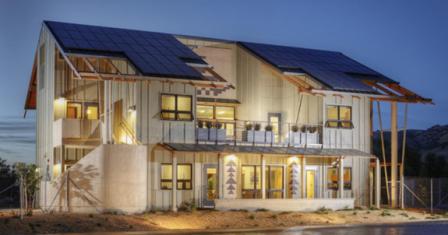 Yocha Dehe Wintun Nation LEED Platinum Maintenance and Operations Building in California. Example of Tribal green building rating system certified projects include:
- Yocha Dehe Wintun Nation Maintenance and Operations Building in California Leave
- Puyallap Longhouse in Washington Exit
- Barona Ring of Mission Indians Tribal Regime Building in California Exit
- Coeur d'Alene Tribe Resort Expansion in Idaho Exit
Green Globes®
Developed past the Green Edifice Institute, Green Globes®Exit is a light-green building guidance and cess program that offers an effective, applied and affordable fashion to advance the overall environmental performance and sustainability of commercial buildings.
Tribal Green Globes® Projects
- Twin Arrows Casino in Arizona Leave
Country, Tribal and Local Green Building Codes
Over 275 cities, counties, and states accept created edifice codes or building programs to increase the environmental and wellness functioning of their communities. Examples of these codes and programs, that can be adopted or adapted by tribes, are covered in the Tribal Greenish Building Toolkit.
Top of Page
Source: https://19january2017snapshot.epa.gov/green-building-tools-tribes/tribal-green-building-code-guidance_.html
0 Response to "Planreview Checklist for Homes and Buildings Navajo"
Post a Comment